Let the light change life

Unlike standard telecom or visible-light fibers, ultraviolet (UV) optical fiber faces a unique challenge: solarization. The high photon energy of UV light can induce color center darkening in the glass, gradually reducing transmission over time. This isn't a gradual aging process—it's a fundamental materials science problem that demands specific countermeasures in fiber design and material selection.
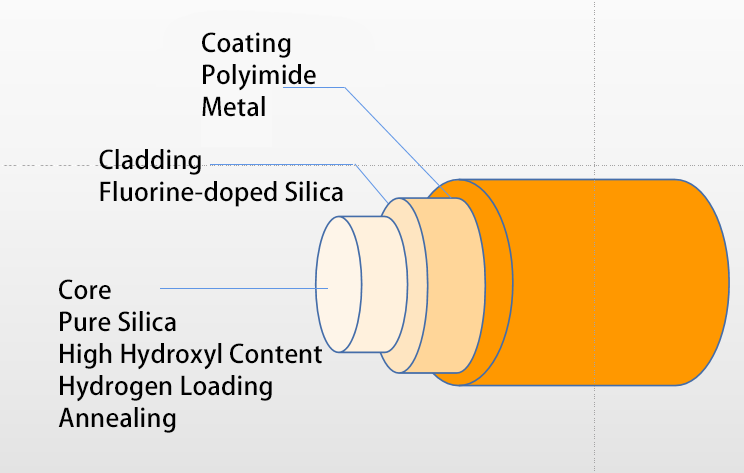
Core Purity: The Non-Negotiable Foundation
For UV transmission, core purity is the first and most critical requirement. High-purity fused silica (SiO₂) is the standard choice, but the tolerance for impurities is far stricter than in other applications.
Take germanium (Ge), for example. It's commonly used in telecom fibers to raise the core's refractive index. However, Ge has a significant absorption band around 240 nm and readily forms Ge-E' color centers under UV irradiation, making it unsuitable. The same goes for transition metals like iron and copper, along with phosphorus and aluminum—all of which introduce UV absorption bands that compromise performance.
Two Practical Approaches to Mitigate UV Damage
With core purity assured, two methods are commonly used to further protect UV fibers:
High Hydroxyl Content (OH⁻)
High concentrations of hydroxyl groups act as a passivation layer within the glass network. They occupy potential defect sites, reducing the probability of UV-induced color center formation. This is why UV fibers typically use high-OH silica—it delivers significantly better transmission in the deep UV range (190–300 nm) compared to low-OH alternatives.
Hydrogen Loading (H₂ Loading)
Exposing the fiber to high-pressure hydrogen allows H₂ molecules to diffuse into the core. These mobile molecules can repair color center defects as they form during UV exposure—essentially giving the fiber a self-healing mechanism. One caveat: hydrogen gradually escapes at room temperature. If a fiber has been hydrogen-treated, it requires proper storage and should be used within a reasonable timeframe to maintain its UV resistance. A gas-tight coating is also recommended.
Cladding Design: Fluorine Doping
The cladding presents another design challenge. Pure silica has a refractive index of approximately 1.458, while the undoped core sits slightly higher. To achieve total internal reflection without introducing UV-absorbing dopants, fluorine (F) is the standard choice. Fluorine lowers the refractive index of silica and introduces virtually no absorption in the UV spectrum, making it an ideal solution for UV fiber cladding.
Coating Selection: Why Polyimide Matters
Coating choice is often overlooked but critical for UV fiber longevity. Standard acrylate coatings—common on telecom fibers—degrade, yellow, and may even fluoresce under UV exposure. These effects compromise both performance and lifetime.
Polyimide (PI) is a widely used alternative. It offers excellent resistance to UV aging and high temperatures, maintaining stable mechanical and optical properties under prolonged UV irradiation. For specialized applications, metal coatings (such as aluminum or gold) are also used, though they add complexity and cost.
If the fiber has undergone hydrogen loading, the coating must also provide adequate gas barrier properties to prevent premature hydrogen escape.
Summary
UV fiber manufacturing follows a different logic than conventional telecom fiber: ultra-pure core, fluorine-doped cladding, UV-resistant coating, and optional hydroxyl passivation or hydrogen loading. Each decision serves a single objective—maximizing operational lifetime and stable transmission under UV exposure.
Hecho Technology offers UV fiber solutions including high-OH silica fiber and polyimide-coated UV fiber, with customization options available. For more information, please contact our technical team.


 IPv6 network supported
 English
 简体中文
简体中文