Let the light change life
In machine vision and industrial inspection, most people focus on camera resolution and algorithm performance. But anyone who has actually tuned a vision system knows — more often than not, the bottleneck isn't the camera. It's the lighting.
Get the lighting right, and defects stand out clearly. Get it wrong, and even the best camera won't save you.
This sounds simple enough. But when it comes to selecting a light source — what to look for, what parameters actually matter — not every engineer has a clear answer. This article walks through three key dimensions: power consumption, stability, and wavelength.
If you've been around industrial lighting for a while, you know that halogen and metal halide light sources used to be the standard. They are bright, but they have short lifespans — typically 2,000 to 3,000 hours. They also generate a lot of heat and require additional cooling.
LED light sources have changed the game. Take Hecho Technology's S5000D series as an example. It consumes only 65W of power, yet delivers light output comparable to a 250W metal halide source. In other words, it achieves similar brightness with less than a third of the power consumption.
With a standard fiber optic light guide, illuminance reaches 800,000 lx at 50mm from the fiber output end. For most high-speed line scan cameras, this is more than sufficient for continuous inspection. And LED lifetime exceeds 30,000 hours — by the time you replace a halogen lamp ten times, the LED might still be running.
Lower power consumption means less heat, less energy use, and lower long-term operating costs. For production lines running 24/7, this makes a real difference.
Brightness alone is not enough. In high-speed inspection, light source stability is often the overlooked variable.
Line scan cameras demand highly consistent illumination. Even small fluctuations in light output can show up as stripes or uneven brightness in high-speed scanned images, making it difficult for the algorithm to distinguish between actual defects and lighting artifacts.
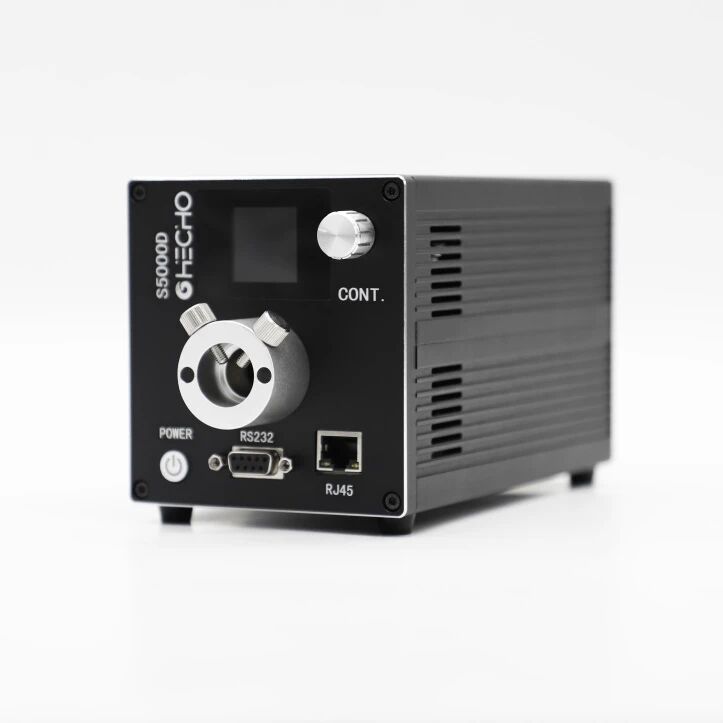
The S5000D uses multi-stage filtering in its circuit design, achieving output ripple within ±2mV. For most inspection scenarios, this is sufficient to avoid image anomalies caused by light fluctuation.
Another parameter that often goes unnoticed is response speed. In strobe lighting applications — such as inspecting moving objects — the light source needs to turn on almost instantly after receiving a trigger signal from the host system. The S5000D responds in under 100ns and supports external trigger frequencies up to 100KHz. In plain terms: trigger signal comes in, light turns on immediately — no delay.
Dimming is continuously adjustable from 0 to 100%, with multiple control options: manual panel adjustment, RS232/RJ45 remote commands, 0-5V analog signals, external 10K potentiometer, and PWM signals. For integration into automated production lines, remote control is the more common approach.
This is a detail that often gets overlooked, but it matters more than you might think.
Different wavelengths of light interact differently with various materials, colors, and surface characteristics. White light isn't always the right choice.
Red light (630nm): Good penetration, suitable for rough surfaces and general illumination
Green light (525nm): Sensitive to scratches on metal surfaces, ideal for highly reflective materials
Blue light (465nm): Shorter wavelength, suitable for high-precision measurement and semiconductor inspection
Warm white light: For applications requiring specific color rendering
So when selecting a light source, it's not just about brightness. It's about what you're inspecting, what type of defects you're looking for, and what wavelength makes those defects most visible. In precision inspection, this is often more important than brightness.
The S5000D series offers all four wavelength options mentioned above, allowing flexible selection based on inspection requirements.
LED cold light sources typically work with fiber optic light guides. The light source sits outside the equipment, and light is delivered to the inspection point through the fiber.
The advantage here is "cold light" — heat generated at the source stays at the source. By the time light reaches the output end through the fiber, there's virtually no heat. For heat-sensitive samples or precision measurement applications, this is a critical consideration.
Fiber selection involves multiple parameters — length, connector type, branch configuration — and the light source and fiber need to be matched properly. Hecho Technology offers complete solutions covering both the light source and the fiber light guide.
Selecting an industrial light source ultimately comes down to balancing a few variables:
Power consumption: Affects long-term operating costs and equipment heat generation
Stability: Affects image quality and inspection consistency
Wavelength: Affects how different defects appear
Lifetime: Affects maintenance frequency and downtime costs
No single light source works for every scenario. The key is understanding your specific inspection requirements and selecting accordingly.
Hecho Technology's S5000D series LED cold light source offers a well-balanced solution across power efficiency, stability, and wavelength flexibility. If you're currently evaluating options for a specific application, feel free to reach out to the Hecho technical team for a discussion.
About Nanjing Hecho Technology Co., Ltd.
Hecho Technology focuses on optical transmission solutions for medical, industrial, and scientific applications. Products include LED cold light sources, halogen light sources, fiber optic light guides, and fiber optic sensors, with OEM/ODM customization available.
Website: www.gohecho.cn | Email: sales@gohecho.cn | Tel: (025)52374096


 IPv6 network supported
 English
 简体中文
简体中文