Let the light change life

The energy consumed by data transmission in computing systems is approaching that of computation itself. This trend is already visible in AI training clusters and high-performance computing centers — the power efficiency bottleneck of electrical interconnects is becoming increasingly apparent, pushing optical interconnect into the spotlight.
Conventional lasers have been deployed in data centers for years, but their high power consumption, temperature sensitivity, and complex packaging limit their potential in chip-scale high-density integration. Micro-LEDs offer a different path. They consume less power, are smaller, provide sufficient brightness, and have natural advantages in the visible spectrum — making them a light source worth serious consideration for short-distance optical interconnects.
However, efficiently coupling light from a Micro-LED into an optical fiber is not a solved problem. A recent study from Peking University used simulation methods to systematically examine which factors have the greatest impact on coupling efficiency and how to optimize them.
The study used the finite-difference time-domain (FDTD) method to model the optical coupling interface between a GaN-based blue Micro-LED array and a multi-core fiber bundle. The Micro-LED emission wavelength was set to 450 nm, and the fiber parameters were based on commercial blue-light transmission fibers.
The researchers examined three factors through controlled simulations.
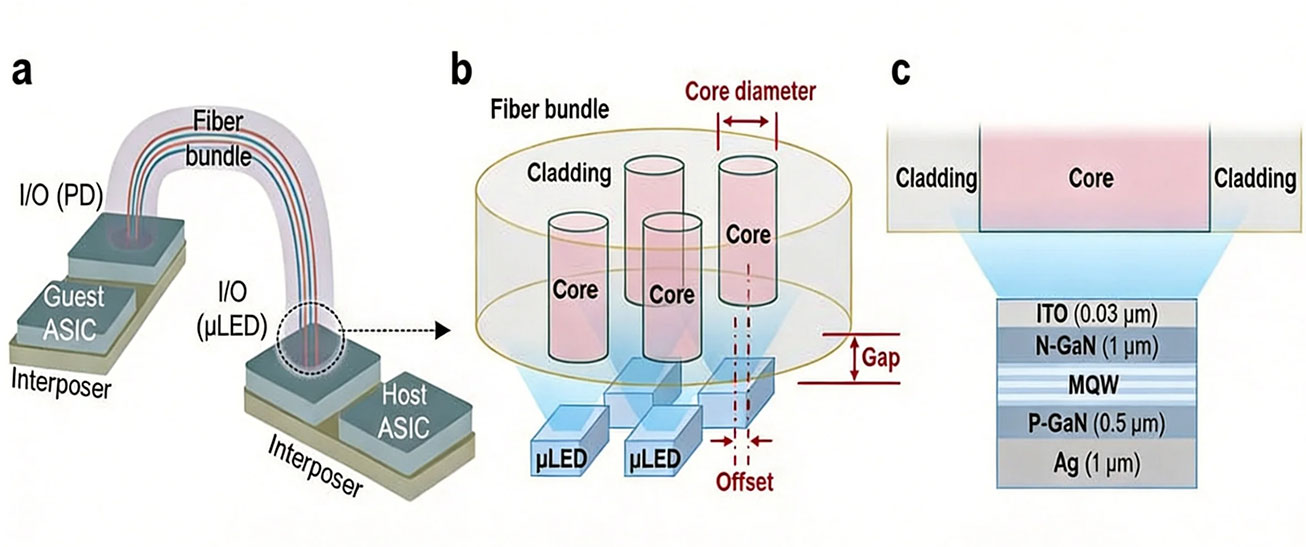
Gap distance
The trend is clear: larger gaps result in lower coupling efficiency. The drop is particularly steep in the 0.1 to 1 micrometer range. The reason is that the optical field of the Micro-LED is highly localized in the near-field region — even a slight increase in gap distance causes energy to dissipate rapidly. Beyond this range, once the system enters the far-field region, the rate of efficiency decline slows significantly.
From an engineering standpoint, this suggests that compressing the gap to within 1 micrometer yields the greatest benefit. Further reduction still improves efficiency, but with diminishing returns.
Core diameter
Larger core diameters improve coupling efficiency — especially in the small-diameter range. Micro-LEDs have a near-Lambertian emission pattern, emitting light in all directions. A larger core captures more of this divergent light. However, beyond a certain diameter, the efficiency gains saturate.
This points to an optimal range — a point where further increases offer little additional benefit. Making the core excessively large may trade off integration density for marginal efficiency gains. A trade-off is required.
Lateral misalignment
Perfect alignment between Micro-LED and fiber is difficult to achieve in practical packaging. The simulation revealed an interesting observation: within ±0.5 micrometers of lateral offset, coupling efficiency shows almost no significant variation. There is a "tolerance plateau" where alignment precision is less critical.
This tolerance comes from the Micro-LED's inherent optical characteristics — its wide-angle emission provides greater latitude in lateral alignment compared to conventional laser sources. For large-scale integration, this is good news.
Building on the above analysis, the study proposed two practical approaches to improve efficiency.
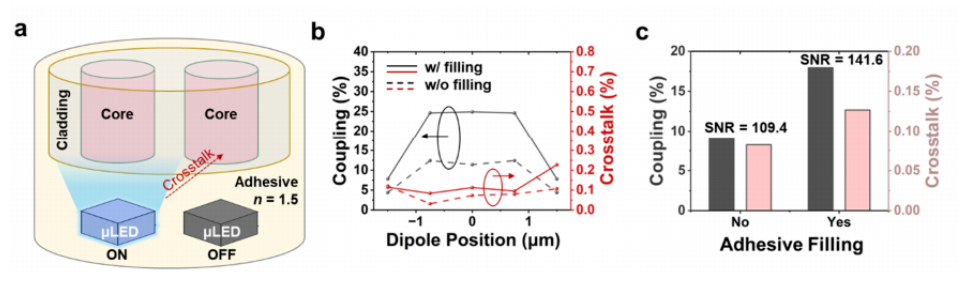
Approach 1: Index-matching optical adhesive
Filling the air gap between the Micro-LED and the fiber with index-matching optical adhesive (refractive index ~1.5) reduces interface reflection and loss caused by refractive index discontinuities. Simulation results showed significant improvement in coupling efficiency, with virtually no change in crosstalk between adjacent cores.
This approach is relatively simple in terms of processing, does not require structural modifications, and is cost-effective.
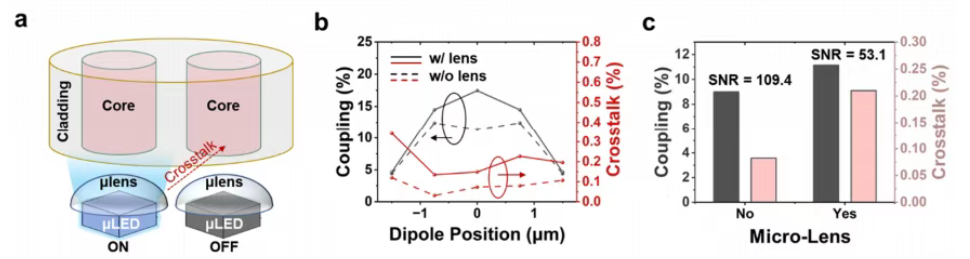
Approach 2: Microlens integration on the Micro-LED surface
Adding a microlens structure on the Micro-LED emission surface reshapes the optical field to direct more light toward the fiber entrance. The study confirmed that spherical microlenses do improve coupling efficiency — but with a side effect: crosstalk increases.
The reason is that spherical lenses have limited control over high-angle emitted light. Aspherical microlens designs could offer further optimization, though both design and fabrication become more challenging.
This study provides several clear conclusions that offer useful reference points for chip-scale optical interconnect system design:
First, the wide-angle emission characteristics of Micro-LEDs naturally reduce alignment precision requirements — a favorable feature for large-scale integration, providing greater packaging tolerance than conventional laser sources.
Second, the design of core diameter and interface structures requires a balance between coupling efficiency and integration density. The optimal choice depends on the specific constraints of each application scenario.
Third, while optical elements such as microlenses can improve efficiency, their introduction requires careful evaluation based on the specific application. A trade-off between efficiency gains and crosstalk control is often unavoidable.
Optical interconnect is steadily moving from board-level and rack-level toward chip-level integration, and Micro-LEDs are worth watching as an emerging light source in this evolution. The fundamental engineering challenge remains: how to efficiently couple light from Micro-LEDs into optical fibers.
From a specialty fiber perspective, improving optical coupling efficiency is never about a single point — the light source characteristics, fiber parameters, and interface treatment all matter. Hecho Technology has extensive capabilities in fiber end-face processing, numerical aperture matching, and custom fiber bundle fabrication, providing end-to-end optical transmission solutions tailored to different light source characteristics and application scenarios. For product specifications and customization options, please contact our technical team.
Source attribution:
This article references the systematic simulation study on Micro-LED to fiber coupling efficiency conducted by the research team at Peking University. The study used the finite-difference time-domain method to model the optical coupling interface between Micro-LEDs and multi-core fiber bundles. All referenced analysis and data are properly attributed to the original study.


 IPv6 network supported
 English
 简体中文
简体中文