English
 简体中文
简体中文
Understanding Numerical Aperture (NA) in Optical Fibers
Numerical aperture (NA) is one of those specs that's easy to overlook when you're choosing a fiber. Core diameter, material, connector type — those get all the attention. But NA directly determines whether light can get in and travel efficiently.
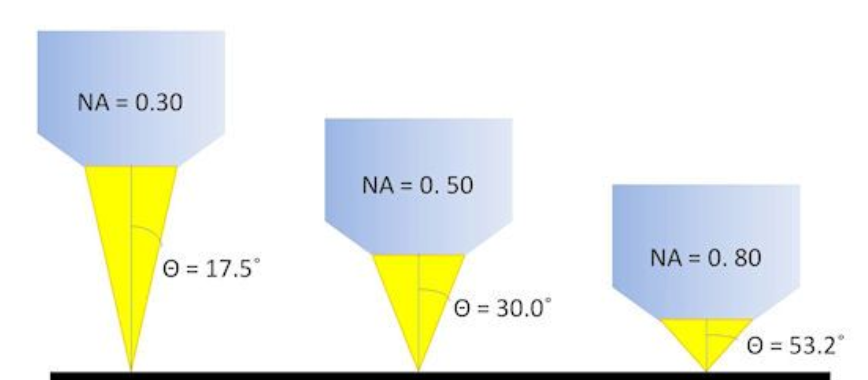
What Is NA?
NA describes the range of angles from which a fiber can accept incoming light. Not all light that hits the fiber end face gets guided. If the angle is too steep, it exceeds the critical angle for total internal reflection and escapes into the cladding. Only light within a certain acceptance cone is trapped and propagates. The sine of that maximum acceptance angle is the numerical aperture.
The formula: NA = √(n₁² − n₂²), where n₁ is the core refractive index and n₂ is the cladding index. The bigger the difference, the larger the NA and the wider the acceptance cone.
What High vs. Low NA Means
High NA = better light collection. For a divergent source like an LED, light sprays in all directions. A fiber with high NA has a wider acceptance cone, so it captures more light. Multi-component glass fibers can have NA above 0.5, with acceptance angles over 120 degrees — great for uniform illumination.
Low NA = fewer modes, lower dispersion. But bigger NA isn't always better. Higher NA supports more modes, and more modes mean modal dispersion — different paths arrive at different times, spreading the pulse. For long-distance, high-bandwidth transmission, low NA is preferred.
So NA is a trade-off: light collection vs. transmission quality. Pick too high, and you get more light but more dispersion. Pick too low, and you get better transmission but struggle to couple light in.
Why NA Matters for Selection
The most immediate consequence of mismatched NA is light that simply doesn't get in.
Take a spectrometer. If the fiber's NA is larger than the spectrometer's acceptance NA, the excess light can't enter the instrument — it's wasted. Conversely, if the fiber NA is smaller, the spectrometer could accept more, but the fiber can't deliver it — also wasted.
The core rule: match the fiber NA to the light source NA and the downstream device NA.
Different sources have very different NAs. Lasers typically have low NA (collimated beam). LEDs have high NA (divergent beam). Pair an LED with a low-NA laser fiber, and most of the light never makes it in. Pair a laser with a high-NA fiber, and you're over-collecting — modal dispersion may hurt transmission quality.
Typical NA Values by Fiber Type
| Fiber Type | Typical NA | Notes |
|---|---|---|
| Singlemode fiber | 0.08–0.14 | Few modes, low dispersion, long-haul telecom |
| Multimode silica fiber | 0.20–0.22 | Industry standard, balanced |
| Multimode glass fiber | 0.3–0.6 | High collection, illumination and sensing |
| Plastic optical fiber (POF) | 0.3–0.5 | High NA, easy coupling, low cost |
Singlemode fiber is around 0.14. Multimode graded-index fiber typically ranges from 0.2 to 0.6. Common multimode NA values include 0.1, 0.22, 0.39, and 0.5 — with 0.22 being the most widely used.
Three Steps for NA Selection
- Look at the light source: Its NA defines the entrance cone. Mismatch means poor coupling.
- Look at the downstream device: What's at the fiber output? A spectrometer, detector, or another fiber? Its acceptance NA determines how much of the output can be used.
- Look at the application: Need maximum coupling? Choose NA that matches or slightly exceeds. Need long-distance transmission? Choose low NA, fewer modes.
Practical tip: If the output spot expands too much over distance (for example, a 0.22 NA fiber produces a ~22mm spot after 50mm), the NA is too high for the application — light diverges quickly. Either shorten the distance or switch to a lower-NA fiber.
What Hecho Technology Offers
Hecho Technology has nearly two decades of experience in specialty fibers, covering plastic, glass, and quartz with NA options from 0.10 to 0.50. We support OEM/ODM customization and can match the right NA to your light source and downstream device.
For help with NA matching, contact the Hecho technical team.